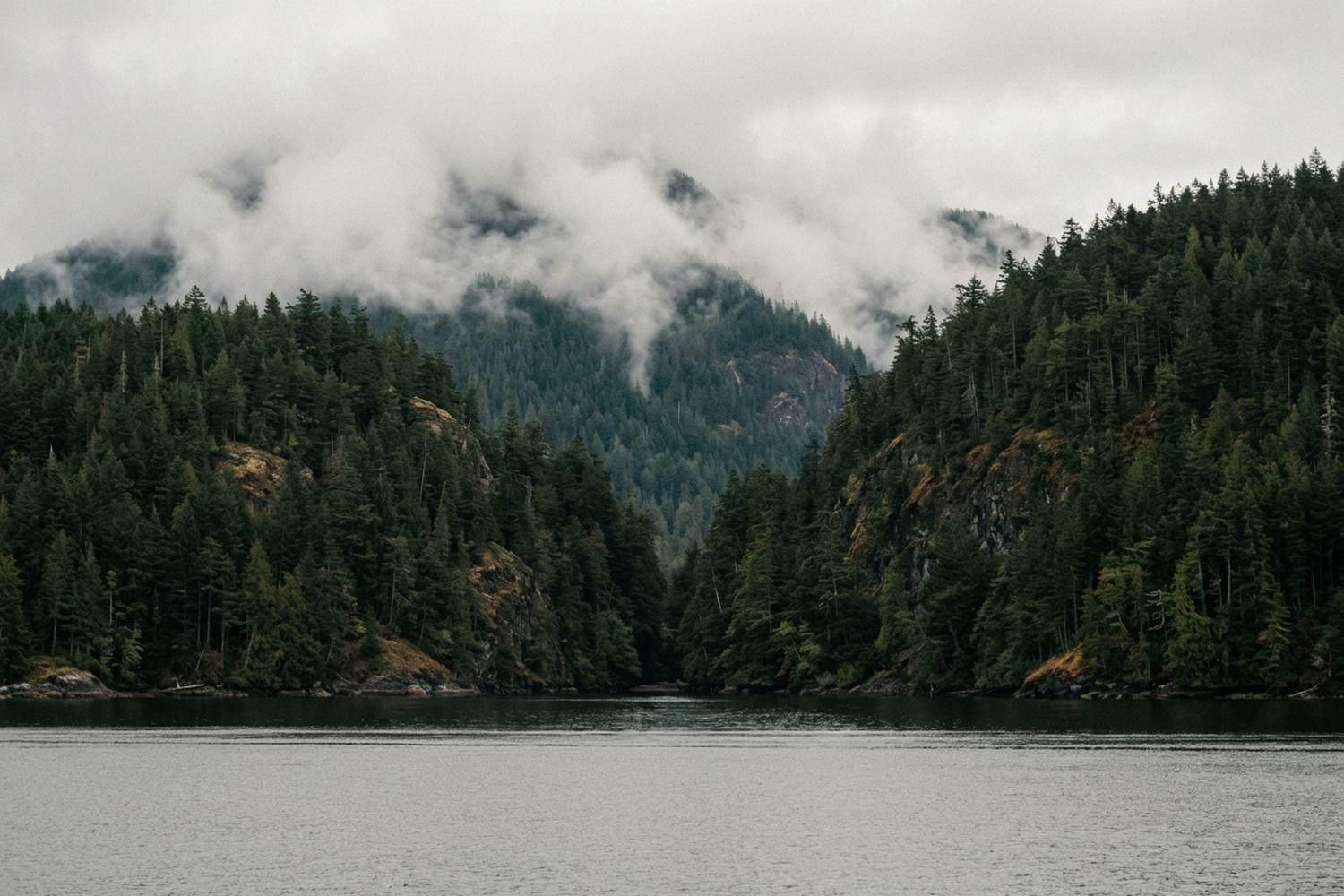
eight nights north of Ketchikan on a forty berth hull
The Inside Passage Small Ship Vacation Package: Eight Nights on Forty Berths
This is an inside passage small ship vacation package on a forty berth expedition hull: eight nights between Ketchikan and Juneau, on a boat small enough to anchor where no road arrives.
Eight nights, from $6,380 per person.
Nothing here counts you and nothing here follows you off the page. One word can be written down, and only the word yes, so this strip stops coming back. What that means in full.
Forty berths is the number that decides everything else about this trip. It is the most expensive package this office sells, at $6,380 per person for eight nights, and people are right to ask why a boat that carries forty costs more per head than a ship carrying two thousand. The answer is arithmetic, not luxury. A captain, a mate, two engineers, a cook and two naturalists cost the same whether forty people sit down to dinner or four hundred do, and on a hull this size that wage bill is divided forty ways.
This inside passage small ship vacation package runs eight nights, embarking at Ketchikan and finishing at Juneau, or the reverse depending on the departure. The distance is roughly six hundred nautical miles of sheltered water between islands, and the boat covers it slowly, often overnight, so that the daylight hours are spent at anchor rather than under way.
The second reason for the figure sits under the waterline. The hull is rated and permitted for waters where larger vessels are not allowed to go, and those permits are counted, capped and paid for annually. Fuel in Southeast Alaska arrives by barge and is priced accordingly. Provisioning happens in two towns and nowhere else for eight days, which means the cook orders for the whole run and stores it aboard.
- What size this is
- About forty berths and one dining room, which means a single sitting at dinner, one skiff rotation that gets everyone ashore in under ninety minutes, and a route that cannot be improvised once the permits are filed.
- What is actually included
- Eight nights in a twin cabin with private facilities; all meals aboard, single sitting, plus coffee and tea between; skiff landings and shore walks with the ship's naturalists; kayak use where anchorage and weather allow; the federal permits the hull carries for protected waters; port transfers in Ketchikan and Juneau on embarkation and disembarkation days.
- Who else is on it
- Roughly thirty eight to forty two people, and you will know every face by the third morning. The whole ship eats at one time, so meals are the social event whether you want them to be or not; there is no second restaurant to escape to. Skiffs carry ten, so each landing runs in four loads and you are ashore with a third of the ship, not all of it. The lounge seats about thirty, which means on a rainy afternoon it is full.
- What it does not include
- Flights to Ketchikan and home from Juneau; hotel nights at either end, which most people want at least one of; bar drinks and wine at dinner; gratuities for crew and naturalists, usually settled in cash on the last evening; laundry, which the ship does not do at this size; rain gear and boots beyond the loaner supply; anything ashore in port on the two town days; the single supplement, which runs high on a hull this small.
- Who should not book this
- Anyone who wants a balcony, a spa, a choice of restaurants or a quiet corner to disappear into. Anyone who needs a firm daily schedule, because the captain moves the route around weather and you will be told at breakfast. Anyone with mobility limits that make a wet skiff landing over a rail impractical, since there is no dock at most of these stops and no way to lift a wheelchair into a small boat at sea.
What forty people do to a day at anchor
The ship carries four skiffs. Each takes ten. That means every landing is four loads, and the whole complement is ashore in about eighty to ninety minutes, which is the practical reason forty is the ceiling for this kind of itinerary. At sixty the last group would be waiting an hour for a beach the first group had already walked.
Ashore, the group splits by pace: a fast walk, a slow walk with the naturalists, and people who stay near the beach with binoculars. Ten or twelve in each. That is small enough that a guide answers questions in a normal voice, and small enough that a bear sighted at four hundred yards is not announced over a loudspeaker to a crowd of hundreds.
The cost of forty runs the other way at mealtimes. One kitchen, one dining room, one sitting, one menu with a vegetarian alternative arranged in advance. If you dislike your table neighbors on Monday you will still be sitting near them on Friday. Nobody has designed an escape route into this boat, because there is no room for one.
from $6,380per person
- Where it comes from
- The lowest figure this office has actually booked this trip at inside the last twelve months.
- Read as
- Two people sharing one room, unless the rows above this say otherwise for your case.
- What lifts it
- A smaller party than the size this trip is filed under, a better grade of room, a peak week, and a late decision.
- When it stops moving
- When an operator puts its own name under it in writing. Until then treat it as the floor of a range this office has seen.
Whatever you settle is settled with that operator, on whatever system it runs. No part of it passes through this office and no card is ever seen here.
The season is short and the shoulders behave differently
Operating runs from late May to early September and not outside it. That is a function of daylight and of the crew, most of whom work another season elsewhere. Rain is the ordinary condition rather than the exception: the temperate rainforest along this coast takes well over a hundred inches a year in places, and a week without a wet day would be unusual in any month.
Late May and early June bring the longest light, close to eighteen usable hours, with snow still on the peaks and waterfalls at full volume from melt. August trades some of that daylight for warmer air and calmer afternoons.
- Late May to mid June
- Longest daylight, heavy meltwater, cold mornings around 45F, fewest boats at the popular anchorages
- Late June to July
- Warmest water for kayaking, most reliable landings, highest demand for the twelve outside cabins
- August
- Salmon running in the streams, most bear activity near tidewater, light shortening by roughly four minutes a day
- Early September
- Coolest air, first storms off the Gulf, itinerary changes most likely, lowest occupancy on the ship
- Outside the season
- The hull is laid up and this package is not sold
What is fixed on the day you confirm
Because the permits and the anchorage slots are filed before the season, the route is settled early and cannot be rearranged for one party. What you decide at confirmation is the cabin, the bed configuration, the dietary arrangement and the arrival plan. Everything after that belongs to the captain and the weather.
- DepositTwenty five percent holds the cabin, taken by the operator directly, not by this office; the cabin number is assigned at that point and does not change
- Documents at eight weeksBalance falls due, and the ship's forms go out: dietary needs, boot and rain gear sizes, next of kin, and any mobility note the crew must know before a skiff landing
- Two weeks outFinal route and anchorage list issued, with the standing note that the captain may vary it; port transfer times for Ketchikan and Juneau confirmed
- Day of embarkationBoarding is mid afternoon, the safety brief is before dinner, and the boat is usually under way by dark
Ask about the cabins before you ask about the price
Twelve of the forty berths look outward at deck level and the rest sit lower, and the difference matters more on this boat than the price difference suggests. Send a message with your travel dates and how many of you there are, and the desk will tell you what is still open and what it actually costs once the single supplement is counted. A message is read the same working day; a full figure takes two to four working days.