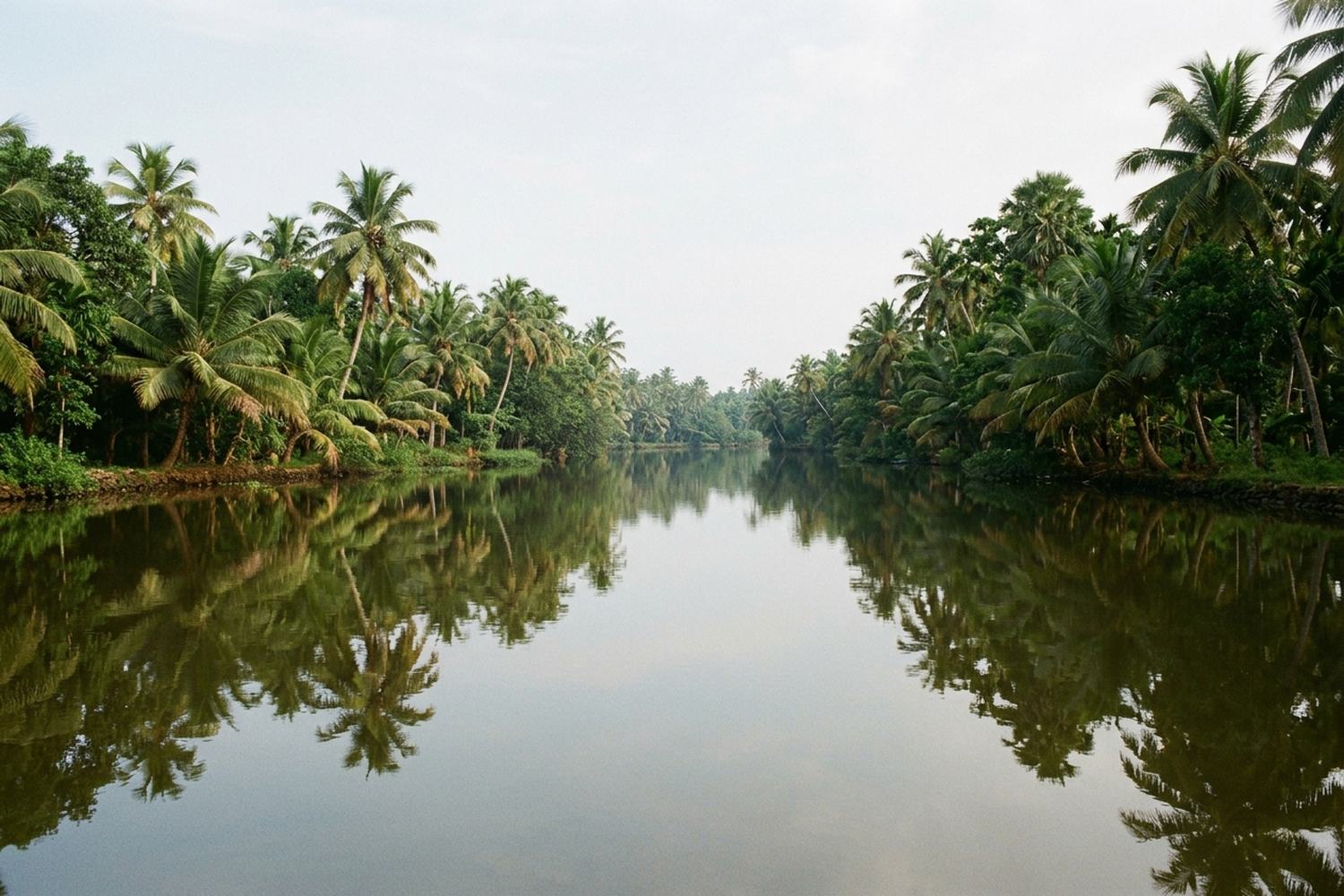
one boat, one car, one guide, nobody else booked alongside you
A Private Kerala Vacation Package: Two Nights Chartered Afloat, Six in Tea Country
This private kerala vacation package puts your party alone on a converted rice barge for two nights, then moves you up 5,000 feet into hill estate country by road.
Eight nights, from $3,240 per person.
Nothing here counts you and nothing here follows you off the page. One word can be written down, and only the word yes, so this strip stops coming back. What that means in full.
The barge sleeps three couples at most and yours is the only booking on it. It is a converted rice carrier, teak and coir rope over a steel hull, with a cook, a helmsman and a deckhand who have worked the same channels between Alleppey and Kumarakom for years. Engine off by six in the evening, moored against a paddy bund, and the only sound after that is water against the hull and somebody's television two fields away.
Eight nights: two afloat, six up in the hills. What makes a private kerala vacation package worth the money here is not luxury, it is control of the clock. The barge does not have to be back at a jetty by a set hour because no second group is waiting to board it. If the light on the water at half past five is worth another twenty minutes, you get another twenty minutes.
The road leg climbs from sea level to around 5,000 feet in about four hours of driving, and it is the single most tiring part of the eight nights. Ghat roads, hairpins numbered on the rock face, tea slopes opening up somewhere around the 1,200 metre mark. Your driver has done it hundreds of times. Nobody else in the vehicle is asking to stop at a different viewpoint than you are.
- What size this is
- Nobody else at all: one boat crewed for your party, one car, one guide who stays with you the whole eight nights, which is why the per head figure sits where it does.
- What is actually included
- Eight nights of lodging, two of them afloat on a chartered barge with cook aboard; all road transport in one air conditioned vehicle with driver; an English speaking guide for the full eight days; breakfast daily, all meals on the boat, two estate lunches; the hill estate walking permits; arrival and departure transfers at Kochi.
- Who else is on it
- Nobody. The barge carries your party and its own crew of three, the car carries your party and the driver, and the guide answers to you alone. On the water you will pass other boats, and at the estate you will share the road with tea workers going to and from the sheds, but no stranger is booked onto your itinerary. The practical effect is that departure times are decided at breakfast rather than printed in advance.
- What it does not include
- International and domestic air; lunches and dinners away from the boat; drinks of any kind including bottled water beyond the boat's supply; treatments, therapies and spa work at the hill property; tips for crew, driver and guide; anything the hill estate charges for jeep hire on its own tracks; entry to sites not named in the itinerary; laundry; any personal medical cost. This office does not sell or advise on insurance, visas or passports.
- Who should not book this
- People who want to swim, because backwater channels are working waterways and nobody swims in them. People with reduced mobility, since the barge is boarded from a low jetty by a plank and the estate paths are steep, wet and unrailed. Anyone who needs a firm daily schedule fixed weeks ahead, because the value here is the opposite. Families hoping the children will find other children on the trip: there are none, by design.
What one guide and no strangers actually changes
A guide talking to two people talks differently than a guide talking to forty. There is no microphone, no head count at the door of a spice warehouse, no waiting for the last person back to the bus. The whole of an afternoon can go on one thing: a coir workshop, a church with Portuguese woodwork, a walk along a bund with a man cutting arecanut overhead. Or you can skip all three and read on the deck.
The cost of that is arithmetic and it is not hidden. A guide costs the same whether two travel or twenty; a barge crew of three costs the same either way; a car with a driver costs the same. Divide those fixed costs by two people instead of forty and you get $3,240 per person rather than something a third of it. What you are buying is the denominator.
It also means small failures are absorbed rather than announced. A road closed by a landslip after heavy rain becomes a rerouted morning, not a coach parked at the barrier while a tour leader phones somebody. In the hills between June and September this happens often enough to matter.
from $3,240per person
- Where it comes from
- The lowest figure this office has actually booked this trip at inside the last twelve months.
- Read as
- Two people sharing one room, unless the rows above this say otherwise for your case.
- What lifts it
- A smaller party than the size this trip is filed under, a better grade of room, a peak week, and a late decision.
- When it stops moving
- When an operator puts its own name under it in writing. Until then treat it as the floor of a range this office has seen.
Whatever you settle is settled with that operator, on whatever system it runs. No part of it passes through this office and no card is ever seen here.
The monsoon argument, which is the whole question of when
Kerala gets two wet seasons and they are not the same thing. The southwest monsoon lands on this coast around the first week of June and runs hard through July, then eases into August. The northeast monsoon returns in late October and November, wetter in the hills than on the water. Between them, and after them, sit the dry windows most people book.
The honest position of this office is that the wet months are not a compromise everybody should accept, and not a mistake either. Tea slopes in July are a color you will not see in February, the barge is far cheaper, and rain on a covered deck for two nights is not a hardship. Estate walking in the same month can be genuinely unpleasant: leeches, mud to the ankle, cloud sitting on the ridge for three days.
- December to February
- Driest and coolest. Hill nights down to the low fifties, days around seventy seven. Highest demand, highest boat charter rates.
- March to May
- Hot and heavy on the water, ninety one and humid at sea level. The hills stay bearable. Boat rates drop through April.
- June to July
- Southwest monsoon at full strength. Heavy daily rain, roads occasionally closed by slips, tea slopes at their best. Lowest figures of the year.
- August to September
- Rain easing, still frequent. Good compromise month if you accept wet afternoons. Backwater levels high.
- October to November
- Northeast monsoon, showers concentrated late in the day. Hills often in cloud. Demand climbing again from mid November.
What gets fixed when you confirm, and what does not
Confirmation locks the boat, the vehicle, the guide and the hill property for named dates. It does not lock a printed hour by hour plan, because that plan is the thing you are paying to not have. The route between Alleppey and the hills is agreed in outline before you fly, and the day's shape is settled each morning over breakfast with your guide.
- QuestionTell the desk your dates, party size and how much road you are willing to do in a day. A figure comes back in two to four working days.
- Deposit and holdA deposit holds the barge and the hill rooms for your dates. Barges for sole use in December and January need the longest lead.
- DetailNames as they appear on tickets, dietary requirements to the boat cook, any mobility limits, arrival flight times so the driver is at Kochi when you land.
- Final documentsVehicle and driver details, guide's name and number, jetty location with directions, hill property address, and a written note of what is not included.
Ask about the dates you have in mind
Tell the desk which weeks you can move and which you cannot, and what you want out of the eight nights: water, hills, or an even split. A message reaches somebody the same working day, and a costed itinerary follows in two to four working days.